Large companies must undertake ESOS energy audits by December 2015
Article 8 of the EU Energy Efficiency Directive requires all Member States to introduce national legislation wherein large undertakings are subject to an ‘energy audit’ every four years. In order to comply with this EU Directive, the UK Government has introduced the Energy Savings Opportunity Scheme Regulations 2014 (ESOS), which requires all large undertakings in the UK to carry out an
ESOS assessment every four years. On 17th July 2014, the ESOS Regulations came into force and the Government expect around 10,000 participants to qualify for the first phase of the scheme.
To view the DECC (Department of Energy & Climate Change) full ESOS Guide please click here
What does ESOS involve
An ESOS assessment is an Energy Audit based on 12 month’s worth of data measuring total energy consumption across buildings, transport and industrial activities. Participating organisations must ensure that at least 90% of their total energy use is subject to an ESOS energy audit. The Energy Audits should also provide participants with recommendations for any cost-effective energy efficiency measures that can be undertaken together with estimated costs and benefits quantified.
Compliance with ESOS requires participants to:
• Measure their energy use for a continuous twelve month period
• Undertake audits covering their main areas of energy consumption
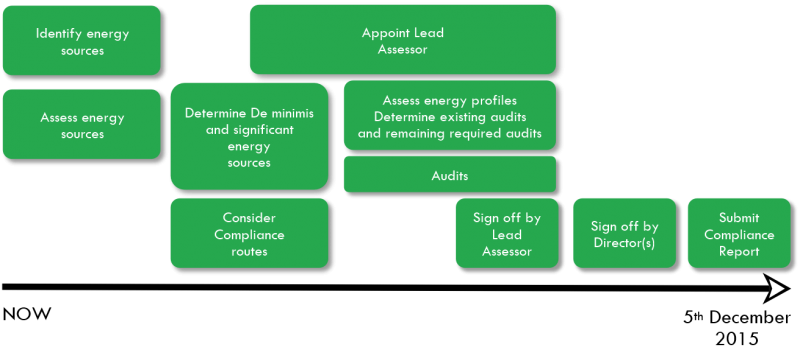
• Report their compliance to the Environment Agency (the scheme administrator for ESOS) by the
compliance date.
It should be noted that compliance with ESOS does not require a participant to undertake all, or any, of the recommended improvement measures, although clearly if there are financial benefits then it will be in the participant’s interests to do so.
Who does ESOS effect?
Participation in ESOS will be mandatory for: large undertakings operating in the UK; and undertakings which belong to a corporate group which includes a large undertaking operating in the UK.
A large undertaking is one which meets any one of the following criteria:
• It has 250 or more employees;
• It has fewer than 250 employees, but has an annual turnover exceeding €50m and a balance sheet exceeding €43m

Implementation and deadlines
ESOS will operate in compliance phases that span four years, with the first compliance date set at 5th December 2015 and the second set at 5th December 2019. Any enterprise qualifying for phase 1 will be required to assess whether they meet the qualifying criteria by 31st December 2014. For Phase 1 of ESOS auditing activity carried out since 6th December 2011 may be used to support compliance.
|
Phase |
Qualification date |
Four-year compliance phase |
Compliance date |
|
Phase 1 |
31st Dec 2014 |
June 2014 – Dec 2015 |
5th Dec 2015 |
|
Phase 2 |
31st Dec 2018 |
Dec 2015 – Dec 2019 |
5th Dec 2019 |
|
Phase 3 |
31st Dec 2022 |
Dec 2019 – Dec 2023 |
5th Dec 2023 |
Compliance alternatives
In line with the Directive, ISO50001 certification is an alternative to an ESOS Energy Audit provided that the scope of the certification covers the participant and that the certification took place within the compliance phase and is still valid at the compliance date of the phase.
Penalties and administration of ESOS
The Environment Agency has been appointed to act as the UK-wide administrator and will be responsible for overseeing compliance and enforcement activity in England. Similarly, Natural Resources Wales, the Scottish Environmental Protection Agency, and the Northern Ireland Environment Agency will be performing similar functions in their respective jurisdictions.
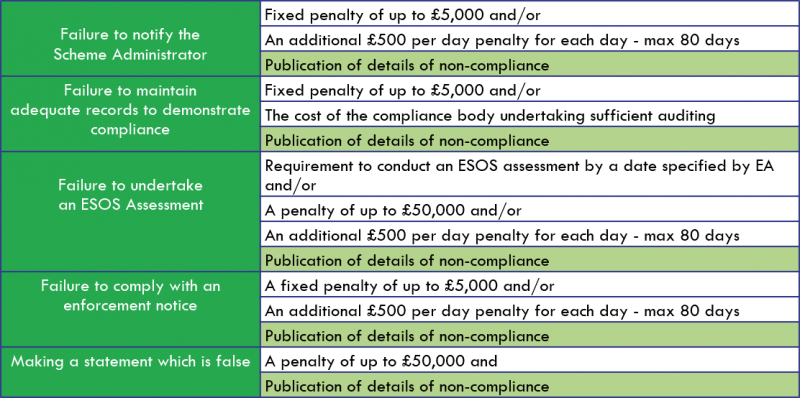
In the event of non-compliance, the scheme administrator has the right to name and shame participants. In addition, non-compliance could lead to financial penalties ranging from £500 for
failing to inform the scheme administrator of compliance by the required date and up to £50,000 for failing to undertake an ESOS assessment or comply with an alternative compliance route, plus £500 per day thereafter (for up to 80 days).
Appointing Lead Assessors
Each participant will need to appoint a Lead Assessor to the ESOS Assessment process, ensuring that work is undertaken by staff with appropriate knowledge and experience and that all areas of significant energy consumption are addressed. Lead Assessors must belong to an ‘approved register’, but can be internal staff or external professionals contracted by the participant.
How AES can help
AES has in-house ESOS Lead Assessors, and ISO 50001 Lead Auditors who have the necessary expertise to assist with ESOS compliance. Our Lead Assessors & Lead Auditors will work with you to ensure that the audit aligns with your business operations and will clearly identify the Return on Investment (ROI) for each of the measures recommended. This will guarantee minimal disruption to your business.